
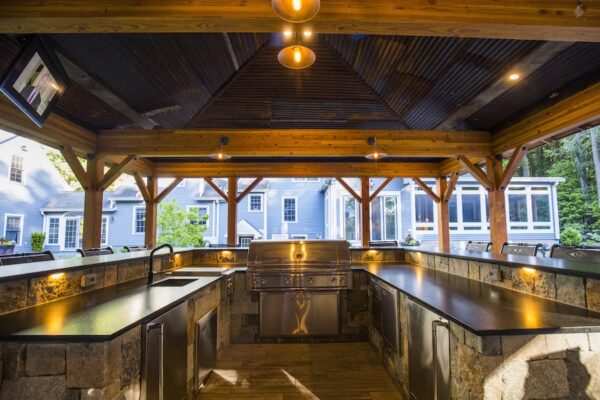
TL;DR: A custom outdoor kitchen installation done well becomes the anchor of an entire backyard — a space you’ll use from May through November and that adds real resale value to a New England home. The right project plans for the region’s freeze-thaw cycles, integrates with existing patio and lighting layouts, and uses materials built to outlast harsh winters. Here at ND Landscape, our team designs and builds outdoor kitchens that are equal parts beautiful and durable. Call 978-352-5400 or contact us online to start the conversation.
What Goes Into a Custom Outdoor Kitchen Installation
A custom outdoor kitchen installation is more than a grill on a stand. At its best, it’s a fully designed space that combines cooking equipment, prep areas, storage, seating, lighting, and shelter into a place your family actually uses — not just on the Fourth of July, but on a quiet Wednesday in October. The challenge in our region is balancing the ambitious build with the realities of New England weather: heavy snow loads, salt-air exposure on the North Shore, freeze-thaw cycles that punish anything cheap, and a relatively short outdoor season that has to earn its construction cost.
Ready to plan an outdoor kitchen for your property? Call ND Landscape Services at 978-352-5400 or contact us online to set up a design consultation.
Plan the Layout Before the Equipment
Most outdoor kitchen projects go wrong when homeowners start by picking the grill and build outward. Start with how the space will be used — and where it sits relative to the house, backyard patio, dining area, and traffic patterns. Three layouts cover most New England properties:
- Linear: A single run of counter and appliances against a wall or property edge. Best for smaller backyards and tighter patios.
- L-shaped: A corner layout that creates a natural division between cooking and seating zones. Most versatile for medium-sized yards.
- U-shaped: A wraparound configuration with multiple appliances and ample prep space. Best for larger properties and serious cooks.
A well-designed outdoor kitchen lives on or alongside the patio, not as a separate island floating in the lawn. Integration with surrounding hardscape and landscape design makes the difference between a kitchen that feels like part of the home and one that feels bolted on.
Choose Equipment Built for the Outdoors
Outdoor appliances are not just indoor appliances with a tan. They’re built with stainless steel rated for outdoor exposure (304-grade is the minimum standard), sealed gaskets, and weather-tested electronics. Common features in a thoughtful build include:
- A primary gas or propane grill, sized to the household plus typical guest count.
- A side burner or power burner for sauces, sides, or seafood boils — under-loved but constantly used.
- An outdoor refrigerator rated for low-temperature exposure so it actually works in October.
- A sink with hot and cold water (where freeze-protected plumbing is feasible) and a built-in trash drawer.
- Smoker, pizza oven, or kamado-style cooker if the household cooks that way — these earn their footprint fast.
- Storage drawers and cabinets in marine-grade stainless or weather-rated polymer.
Materials Matter More Than You Think
The frame, counters, and cladding determine whether the kitchen will look the same in ten years or start spalling and shifting after two. For our climate:
- Frames should be steel stud or block, never wood. Wood frames trap moisture and rot from the inside out.
- Counters should be either dense natural stone (granite, soapstone) or porcelain slab — both handle freeze-thaw and UV exposure. Avoid honed marble outdoors.
- Cladding can be stone veneer, brick, or stucco over a proper rainscreen — coordinated with the home’s exterior for a built-in look.
- All plumbing should be designed for seasonal shutdown, with shutoffs and blowout fittings accessible.
- Electrical receptacles should be GFCI, weather-rated, and on dedicated circuits that can handle multiple appliances.
Plan for Shelter, Light, and Comfort
A great outdoor kitchen extends the season far past mid-July. A pergola, pavilion, or retractable awning shelters the cook from sun and rain, while integrated lighting makes the space genuinely usable after sunset — which is most of the time in October and November. Layered lighting works best: warm overhead light for the cooking and prep zone, softer accent lighting on surrounding plantings, and low-voltage path lighting connecting the kitchen to seating areas and the house.
A fire pit or fireplace nearby anchors the seating zone and extends the season further — especially valuable in New England, where cool evenings start in September.
Build for New England Winters from Day One
Every successful outdoor kitchen in our region has a winterization plan designed in from the start. That means accessible water shutoffs, slope built into countertops so water sheds, drains where needed, equipment covers sized correctly, and a clear protocol for the last weekend of the season. Skipping winterization is the single biggest cause of costly damage in our climate — split pipes, ruined refrigerators, and cracked stone are entirely avoidable.
Snow loading also affects shelter choices. A pergola with a polycarbonate or metal panel roof rated for our snow load is worth the upgrade over a basic open pergola, especially if the kitchen sees winter use. Pavers and patio surfaces beneath the kitchen should be on the same robust gravel base used for any quality New England hardscape so they don’t heave under appliances.
Budget and Timeline Realities
Custom outdoor kitchen pricing in the Boston metro and North Shore market typically starts in the mid-five-figures for a basic L-shaped build with quality components, with full pavilion-and-kitchen builds running well into the six figures. The biggest line items are usually masonry, appliances, gas and electrical, and shelter. A realistic timeline runs four to eight weeks of active construction, plus design and permitting time on the front end. Most projects work backward from a target use date — Memorial Day is a common goal, which usually means design and permitting in the prior fall.
Build an Outdoor Kitchen Your Family Will Actually Use
The best custom outdoor kitchen installation is one that fits the way your family already lives — designed to extend, not duplicate, what happens indoors. Get the layout, materials, and weather plan right, and you’ve built a space that earns its cost across decades of New England seasons. Get them wrong, and you’ve built an expensive grill stand.
Want to design something built to last? Call ND Landscape Services at 978-352-5400 or contact us online. Our team handles full landscape construction — outdoor kitchens, patios, fire features, and integrated lighting — across Massachusetts and Southern New Hampshire.
Frequently Asked Questions About Custom Outdoor Kitchen Installation
How much does a custom outdoor kitchen installation cost in Massachusetts?
Most quality builds in the Greater Boston and North Shore market start in the $40,000–$60,000 range for a modest L-shape with mid-tier appliances. Larger projects with pavilions, premium appliances, and full masonry work commonly run $100,000 and up.
How long does a custom outdoor kitchen take to build?
Plan on four to eight weeks of active construction once permits are issued, plus four to ten weeks for design, material lead times, and approvals. Starting design in the fall is the most reliable way to be cooking outside the following Memorial Day.
What’s the most durable countertop for an outdoor kitchen in New England?
Dense natural stones like granite and soapstone handle freeze-thaw, UV, and salt-air exposure well, as do porcelain slabs designed for outdoor use. Avoid honed marble, concrete that hasn’t been properly sealed, and tile that can crack with thermal movement.
Do outdoor kitchens add value to a home?
Yes, particularly in higher-end markets like the North Shore and Boston suburbs. Outdoor kitchens generally recover a substantial portion of their cost at resale and consistently shorten time on market, especially when integrated with patios, fire features, and lighting.
Can an outdoor kitchen be used in winter?
The cooking equipment can be used year-round, but plumbed components (sinks, refrigerators, ice makers) need to be winterized before consistent freezes set in. A sheltered design with a pavilion roof and radiant heat extends comfortable use deep into fall and out of light snow.
Does ND Landscape Services handle custom outdoor kitchen installation?
Absolutely. Here at ND Landscape, our team designs and installs custom outdoor kitchens, patios, pergolas, fire features, and integrated lighting as full residential landscape projects. Call 978-352-5400 or contact us online to schedule a design consultation.